
Waterproofing & fire · Service line 07
Passive Firestopping
In brief
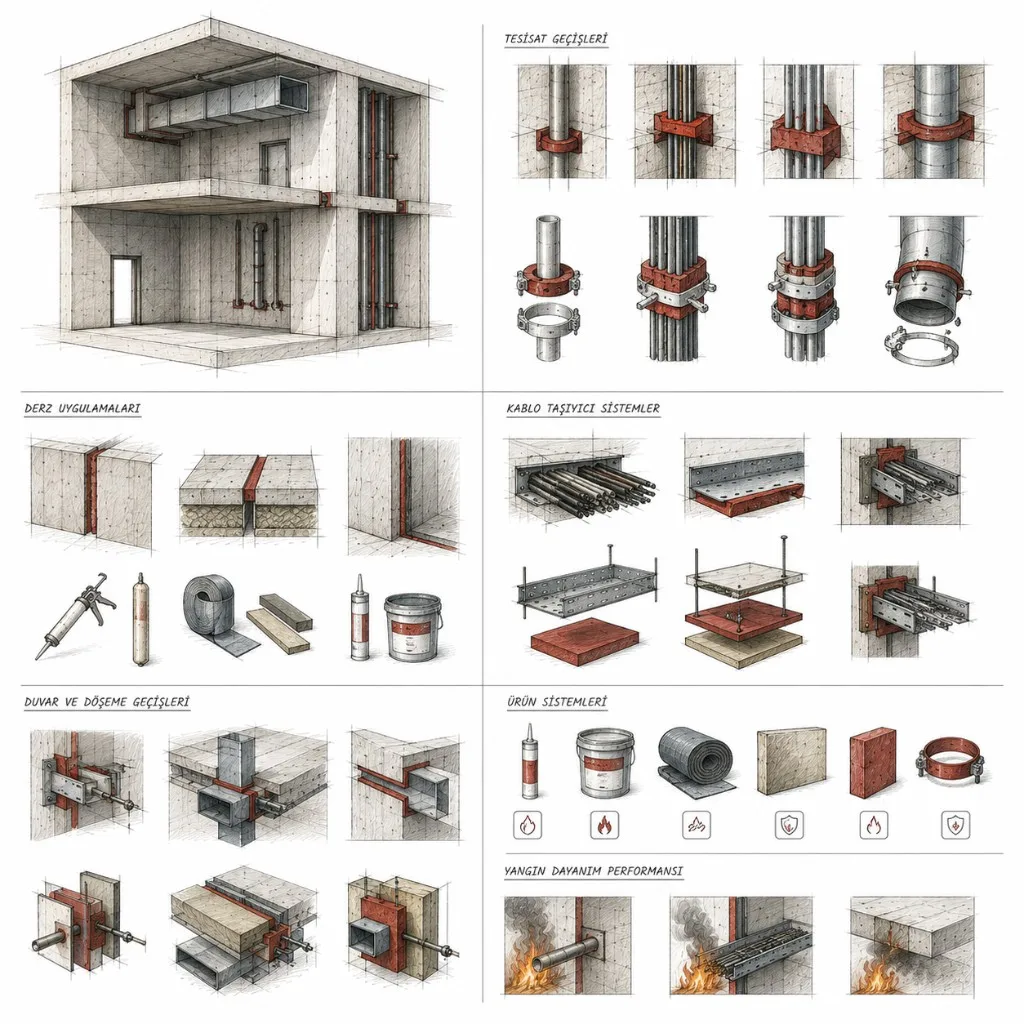
Passive firestopping is the system that prevents fire and smoke spreading between compartments by sealing service penetrations and structural joints. Every point where a cable, pipe or ventilation duct passes through a wall or floor is sealed — for the required fire resistance period — with sealant, pillows, collars or mortar classified to EN 13501-2.
In a building that complies with fire regulations, walls and floors are designed to hold back fire for specified periods. But the first cable tray to pierce that wall reduces the calculated resistance to nothing. Passive firestopping seals those openings and makes the compartment whole again.
The work is not simply a matter of applying material. Every type of penetration has a classified system detail, and it must be documented which material was used, at what thickness, in which supporting construction. That is precisely what is asked for in the fire report and at the completion inspection.
Where is it applied?
Every point that pierces a fire compartment is an application area:
- Cable and cable tray penetrations — pillow, sealant or foam systems
- Combustible plastic pipe penetrations (PVC, PP) — intumescent collars
- Metal pipe and ventilation duct penetrations — fire mortar and sealant
- Floor-to-facade perimeter joints — fire wool and sealant detail
- Perimeter details of fire doors and smoke curtains
- Separations of riser shafts, lift wells and stair cores
Documenting the work
Passive fire protection is work that gets covered up once it is done, so producing evidence is part of the job. We number every penetration, photograph it before and after, and file it together with the Declaration of Performance (DoP) and the classification report of the system used. That file can be used directly in the fire brigade compliance letter and the building inspection process.
What the scope covers
- Cable, pipe and duct penetration seals
- Firestop sealant, pillows and collars
- Floor, wall and facade joints
- Photographic records and system compliance file
Frequently asked questions
What is the difference between passive firestopping and an active fire system?
Active systems (sprinklers, detection, smoke extraction) try to extinguish the fire or raise the alarm; they need power and a trigger. Passive systems delay the spread of fire simply by being there, with nothing to trigger. The time needed for evacuation is created above all by passive protection.
To what standard is firestopping carried out?
In Türkiye the governing document is the Regulation on Fire Protection of Buildings; product and system performance is tested to the EN 1366 series and expressed to EN 13501-2 in classes such as EI 60, EI 90 and EI 120. The installation must match exactly the detail in which the product was tested; otherwise the classification does not hold.
Can it be done retrospectively in an existing building?
Yes, and this is the work we meet most often. In existing buildings we first map all compartment boundaries and the penetrations that pierce them, then select the appropriate system for each type. Because services are installed after the structure, most buildings contain dozens of unsealed penetrations.
Quote
Get a price for Passive Firestopping
Share the dimensions and the current condition and we will price it item by item. In Samsun and the surrounding provinces we come out for the survey ourselves.
Çobanözü Mah. Toybelen Küçük Sanayi Sitesi, Atakum / Samsun